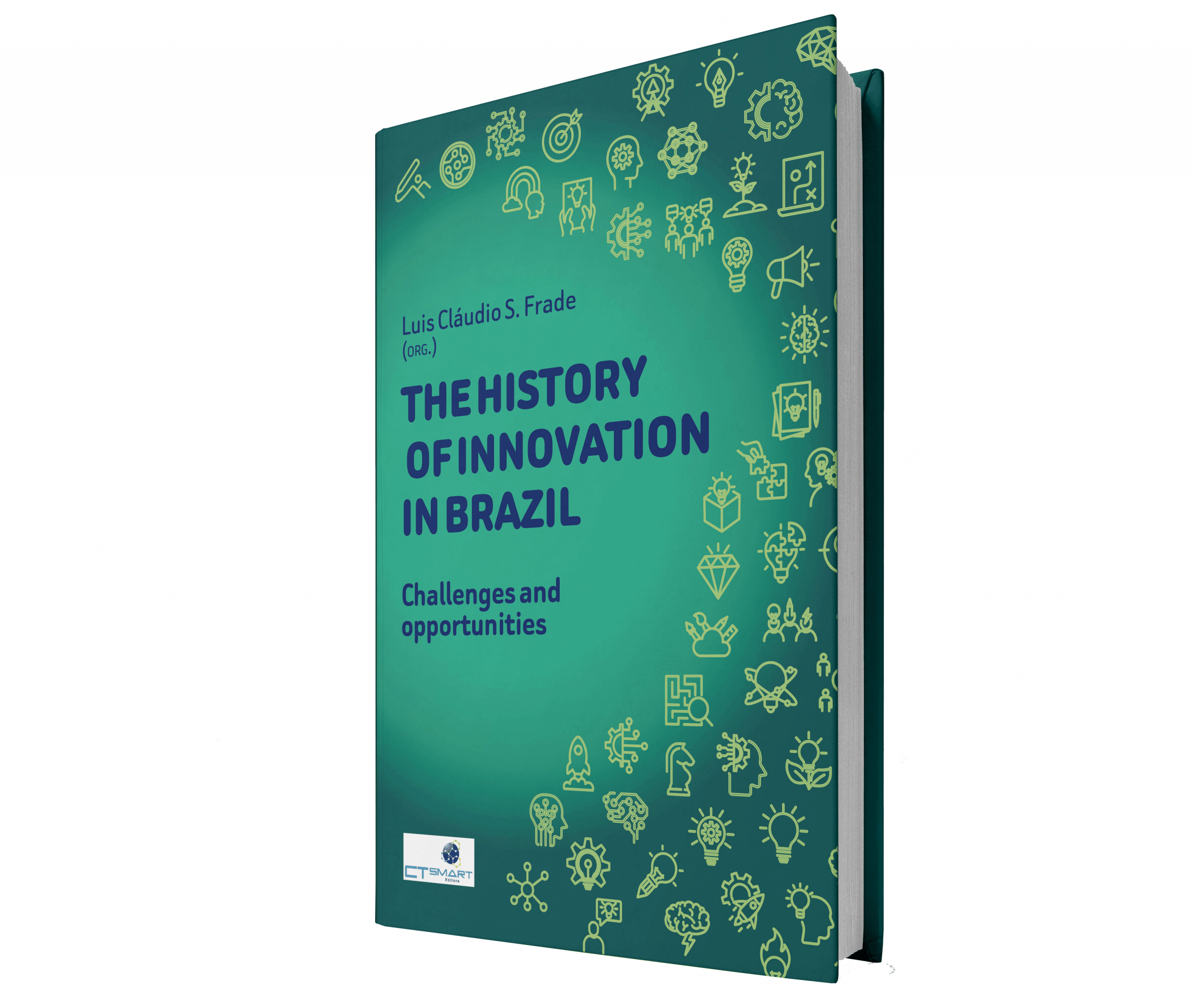
E-book and Printed Book
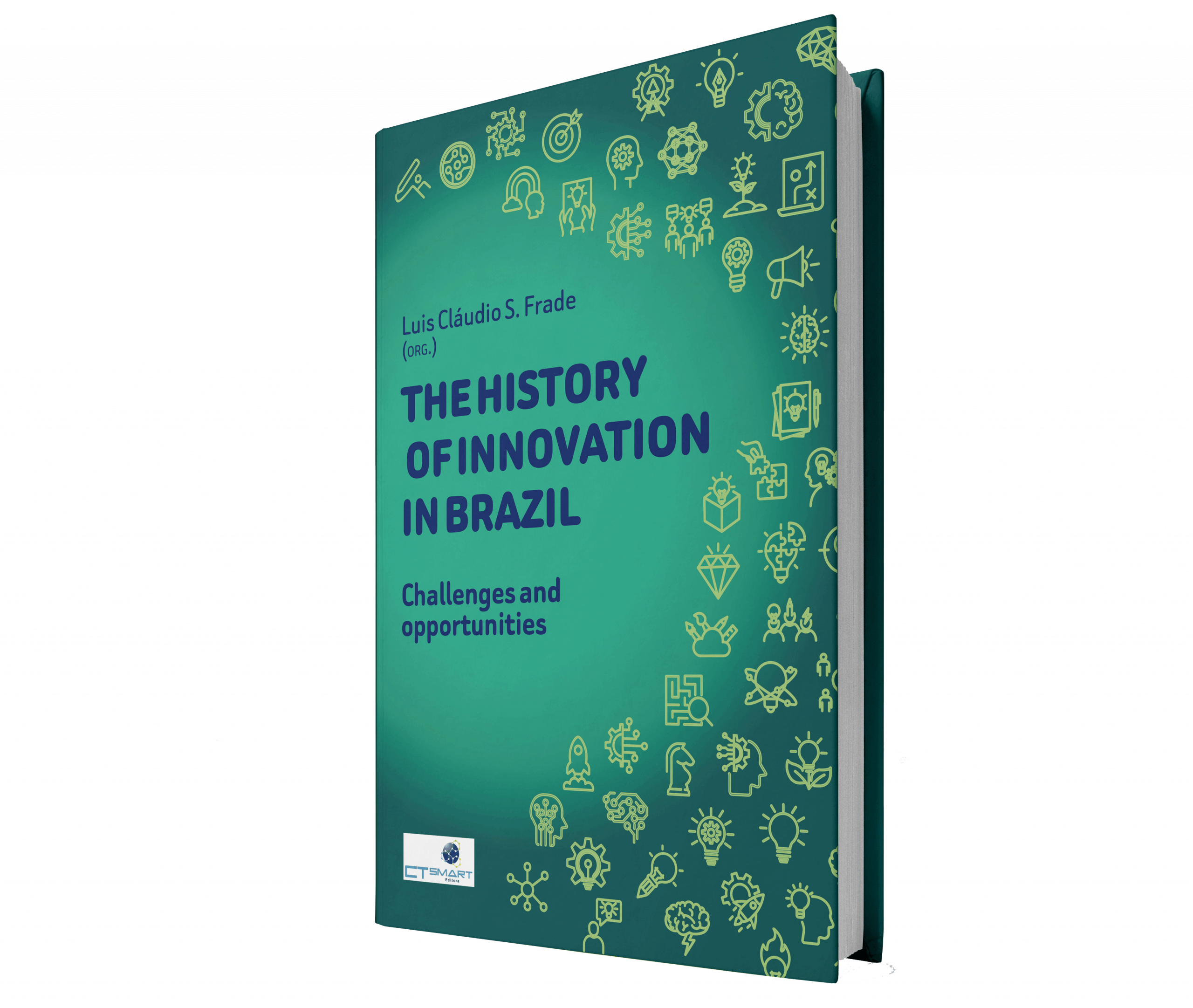
The History of Innovation in Brazil – Challenges and opportunities.
A journey through time, from the perspective of those who participated or participate in the history of innovation in Brazil.
The story behind the book
This book is the reult of Luis Cláudio S. Frade's passion for the topic of innovation, which led him to fully engage in its creation, convincing other enthusiasts from various specific fields to join the effort. These contributors bring not only vast knowledge but also practical experience, ensuring a broad and comprehensive perspective on the framework, execution, and key players in innovation. It is important to highlight that no effort was made during the coordination and review process to impose a single line of thought, and this becomes evident throughout the book. This can actually be seen as an advantage, as the overlapping perspectives across chapters allow for multiple interpretations. As a result, the reading experience guarantees valuable learning.
Motivation
Throughout these years, I always felt the absence of a book that could tell the
history of innovation in Brazil, incorporating varied opinions and perspectives based on
the experiences of different professionals—whether in companies, scientific and
technological institutions (ICTs), academia, or the government .
Contextualization
-
No work was found that reported the history of innovation in Brazil, from the time of the empire to the present day, covering various segments or themes related to innovation;
-
There is a lot of material on innovation in books, theses, dissertations, magazines, and technical articles, covering a specific part of one or some themes related to innovation;
-
This book was written with the intention of addressing these gaps:
-
Composed of 16 chapters, on average, each written by three different authors;
-
In total, there are 47 authors with expertise in companies, academia, Government, class representative entities, among others, who participated;
-
Additionally, a committee consisting of two specialists was created to assist in the technical evaluation and review;
-
It is non-profit and will be distributed electronically;
-
4 organizations sponsored the review, layout, and first printing: WEG, Cisco, ii Intelligence For Innovation, and Itaipu Parquetec.
Thus, the organization of this book was initiated in August 2022.
The book will not be sold in bookstores. An agreement was made with the co-authors at the start of the book project not to sell it.
It is important to record part of the history of the book:
Timeline of the work:
- August 2022
This project was initiated (writing an innovation book with several co-authors).
- September 2022
A draft was prepared, sent to many innovation friends, and suggestions and comments were collected. Many of these suggestions were accepted.
- November 2022
The book project was presented to some innovation friends at the ANPEI Innovation Conference in Campinas. At this conference, some of them were invited to join the project as co-authors. Most accepted.
- Between December 2022 and February 2023
Other co-authors were invited to join the project and many of them agreed. In total, 47 authors joined the book project.
- Mid-March 2023
Many WhatsApp messages were sent to confirm interest in participating in the book project. A review committee composed of three people was created to help with the review and organization of the chapters.
- On May 5, 2023
A videoconference was organized with all authors. Many doubts were resolved in this meeting.
- Between May and June 2023
Specific meetings were organized with authors of each chapter separately. In total, 15 meetings were held.
- On June 30, 2023
I organized a second alignment meeting.
- On July 1, 2023
Authors began working on their chapters. They were not given a fixed deadline, but there was a schedule in mind: December 2023
- In January 2024
Nine chapters were completed with minor adjustments.
- Between February and June 2024
Five more completed chapters received.
- In May 2024
A review team composed of three people was hired because the plan was to finish the book in mid-July 2024.
- On July 24, 2024
Received the copydesk from the review team.
- On July 30, 2024
Received the last chapter and sent it to the review team.
- On August 7, 2024
Finalized my review on the copydesk and sent it back to the review team.
- On August 19, 2024
Launch of the book's website.
- On September 25, 2024
Launch of the physical book and e-book.
Investments
There are some very interesting numbers, facts, and data about the book.
- Two 2-hour meetings with nearly 25 authors = 50 hours of work.
- 16 chapters with 476 pages containing 171,811 words or 1,160,304 characters (with spaces).
- Estimated that each co-author invested at least 10 hours in their texts. Thus, in total, more than 470 hours were spent on the book project.
- I spent more than 400 hours coordinating all the book's activities.
- I assumed that the review team, composed of three people, spent 80 hours reviewing the book's content.
- 1,500 books will be printed in the first edition.
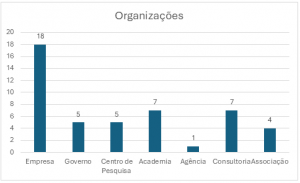
The co-authors belong to seven different types of organizations, and most of them work in companies.
Four book launch events will be held in São Paulo, Rio de Janeiro, Belo Horizonte, and Campinas. There is the possibility of two more cities receiving a book launch event: São José dos Campos and Brasília.
Objectives achieved and demonstrated
Diverse Perspectives
16 chapters full of different opinions and points of view on innovation, from the time of the empire to current challenges.
Innovation in Focus
Addresses everything from the Innovation Legal Framework to the crucial role of startups and international cooperations.
Cases of Success
Practical and inspiring examples of innovation in Brazil, directly from research centers and companies.
Recommendations, Suggestions, and Opportunities
Real and evidence-based proposals to improve the innovation environment in our country.
Brazilian National Innovation System
Como foi pensado e planejado o SNI, os atores e suas interreelações, assim como o status atual do mesmo
Innovation Centers in Brazil and their types
Contextualization, modes of operation, and examples of reference R&D+I centers.
Book Chapters
| Title | Chapter | Co-Author(s) |
| Chapter 1. Innovation in Brazil | In this topic, the idea is to show the origin of innovation in Brazil, from the arrival of the royal family to current times, contextualizing some actors in general. | Shirley V. Coutinho |
| Marli Elizabeth Ritter | ||
| Chapter 2. Legal Framework for Science, Technology, and Innovation | It discusses how this framework was built over the years and its current status. In the Brazilian case, a timeline should be used to show each of these phases. Similarly, it intends to present improvement suggestions at the end of the chapter. | |
| Carina Leão | ||
| Leonardo Garnica | ||
| Juliana Crepalde | ||
| Gesil Amarante | ||
| Chapter 3. National Innovation System | In this topic, it is intended to present each of the actors that make up the Brazilian National Innovation System, their roles, and their relationships. The role and relevance of each actor should also be discussed. | |
| Maria Beatriz Machado Bonacelli | ||
| Carlos Antônio Medeiros Gambôa | ||
| Anapatrícia Morales Vilha | ||
| Chapter 4. Ministry of Science, Technology, and Innovation | In this specific topic, the idea is to present all the phases that innovation went through within the Government until it became a ministry. A timeline should also be used to show all the details along this path. | Paulo Alvin |
| Gesil Amarante | ||
| Chapter 5. Innovation Ecosystems | This is the core of different innovation systems around the world. The idea here is to present a macro diagram showing all innovation actors and explore each of them in detail. A success case is presented at the end. | Ricardo Yogui |
| Guilherme de Oliveira Santos | ||
| Juan Carlos Sotuyo | ||
| Chapter 6. Innovation Centers | Special attention will be given to this topic regarding innovation centers. I believe this commentary is important to present their importance within the context of the Brazilian innovation ecosystem. There are many reference research centers in the country, and the success cases should come from them. Three success cases are presented. | Sebastião Sahão Junior |
| Jefferson de Oliveira Gomes | ||
| Paulo José Pereira Curado | ||
| Pedro Porto Silva Cavalcanti | ||
| Cristina Assimakopolous | ||
| Chapter 7. From Research and Development (R&D) to Open Innovation | This chapter explains the process of transformation from predominant research and development activities to network-based activities, focusing on open innovation. International experiences and the changes that occurred in Brazil for this new modality of innovation are discussed. Success cases from Brazilian organizations were added at the end of the chapter. | Fábio Makita |
| Sebastião Nau | ||
| Eduardo C. Peixoto | ||
| Chapter 8. Startups in the Context of Innovation | Currently, startups are a new actor in the entire innovation ecosystem. Therefore, the chapter shows the opportunities these actors have now and in the future. What has evolved in Brazil in recent years (Legal Framework for Startups) is presented. | Cassio Spina |
| Thiago Pereira Soares | ||
| Mariana Yazbeck | ||
| Ricardo Yogui | ||
| Chapter 9. International Cooperation for Innovation | Three international cooperation initiatives for innovation that occurred over the years are presented, along with how they were built and what lessons can be drawn from them. Proposals for improvement opportunities in these partnerships are presented. | Filipe Cassapo |
| Tatiana Farah de Mello Cauville | ||
| Gianna Sagazio | ||
| Alessandra Holmo | ||
| Chapter 10. Funding Resources for Innovation | Resources for innovation are a very important theme discussed among various innovation managers from different companies. The evolution of resource funds should be presented, and new mechanisms are discussed here. Improvement suggestions are also presented. | Maria Carolina Rocha |
| Bruno Bragazza | ||
| Marcelo Camargo | ||
| Marcelo Bortolini | ||
| Chapter 11. Human Resources for Innovation | People are the most valuable assets of the innovation ecosystem. They are the ones who “make innovations happen,” especially in companies. This topic identifies best practices in the training of human resources for innovation. Attention is also given to knowledge management. A success case was included, and opportunities for improvement in the training of these people in the country are discussed. | Rafael Navarro |
| Raimar van den Bylaardt | ||
| Jorge Almeida Guimarães | ||
| Chapter 12. Innovation from Science and Technology Institutions | This topic addresses the evolution of innovation in science and technology institutions based on international models, bringing it into the country's historical context and citing some cases. It compares educational institutions that are references in this area. | Marli Elizabeth Ritter |
| Ana Torkomian | ||
| Luiz Eugênio Mello | ||
| Chapter 13. Entrepreneurial Culture for Innovation | It is observed that the most innovative organizations are those that stimulate a culture of innovation perennially sponsored by senior management. The idea of this topic is to evaluate how this has been developed in the country and what can be improved. | Ricardo André Marques |
| Renato Dias Regazzi | ||
| Danielle Moraes | ||
| Chapter 14. Corporate Governance for Innovation | The way organizations manage innovation determines whether they will be successful or not in their businesses. It evaluates how successful companies handle this management in Brazil based on a conceptual proposal from IBGC. At the end of this chapter, improvement opportunities are presented. | Ruy Quadros |
| Denis Balaguer | ||
| Chapter 15. Intellectual Property as a Strategic Tool for Innovation | Many countries treat this issue in different ways. There are accelerated processes in some countries, but others have very different methodologies for dealing with intellectual property. In this context, the evolution of IP in Brazil over the years is presented. Success cases will also be presented. | Patrícia Leal Gestic |
| Ricardo Boclin | ||
| Eneida Berbare | ||
| Chapter 16. Innovation and Sustainability | This item was recently incorporated into the innovation agenda. World organizations are discussing this extensively. Now, it is important to evaluate how other countries are managing this theme and what Brazil's role is in this context. Innovation can contribute on both sides: as an inducer of the development of new components, machines, products, etc. to reduce environmental problems and, on the other hand, as a solver of environmental challenges through innovation. Cases are presented throughout the chapter. | Christimara Garcia |
| Claudia Pocho | ||
| Heloísa Menezes |
Authors
The project was built by many hands: there are 47 experienced co-authors and specialists in innovation, with activities in companies, ICTs, academia, and the Government.
Recently launched at the end of 2024, the work is composed of 16 chapters, filled with different opinions and points of view
A work that reported the history of innovation in Brazil, from the time of the empire to the present day, passing through various segments or themes related to innovation, had never been found.
Luis Cláudio Frade
Don't miss the launch!
Nine special and innovative events to celebrate
Don't miss the launch of the book The History of Innovation in Brazil at the in-person launch events that will take place in São Paulo, Campinas, Rio de Janeiro, and Belo Horizonte.
Rio de Janeiro
Sept. 25th
Local
iUP Innovation Connections, ROG.e 2024, at Espaço Kremer – Boulevard Olímpico
Belo Horizonte
Oct. 30th
Local
P7 Criativo - R. Rio de Janeiro, 471 - Centro, Belo Horizonte - MG
Balneário de Camboriú
Oct. 31st
Local
12th Brazilian Congress on R&D in Oil, Gas and Biofuels – PDPETRO, in the city of Balneário Camboriú - SC
Campinas
Nov. 4th and 5th
Local
FORTEC 2024 - PUC - Campinas - Rodovia Dom Pedro I, Km136, Parque das Universidades
São Paulo
Nov. 19th
Local
Auditório Tech da ESPM - R. Joaquim Távora, 1240 - Vila Mariana, São Paulo
Foz do Iguaçu
Nov. 27th to 30th
Local
Itaipu Parquetec – Foz do Iguaçu/PR